
Concrete Seawall
Concrete Seawall Contractor Cape Coral, FL
In Cape Coral, concrete is the most widely installed seawall material — and for good reason. Engineered to withstand Florida’s tidal cycles, storm surge, saltwater corrosion, and hurricane-force conditions, a properly built concrete seawall delivers 30–50 years of structural protection for your waterfront property. Cape Coral Seawall designs, installs, and repairs concrete seawalls for residential and commercial properties across Cape Coral, Fort Myers, and Port Charlotte.
Why Concrete is Cape Coral's Most Trusted Seawall Material
Cape Coral’s canals were engineered for concrete. When the city was developed in the 1950s and 60s, reinforced concrete became the standard seawall material under Lee County code — and for decades it was the only permitted option. The city’s 2022 updated construction standards now allow vinyl in certain conditions, but concrete remains the dominant material for high-exposure shorelines, river-adjacent properties, and sites requiring maximum structural mass.
Concrete seawalls handle what Cape Coral’s waterways produce daily — tidal fluctuation, boat wake, storm surge, and the constant hydrostatic pressure of water-saturated soil. When properly designed with adequate reinforcement, weep holes, and cap integrity, they outlast every other material option in Southwest Florida’s marine environment.
Request A Free Consultation
Please Fill The Form
Concrete Seawall Installation in Cape Coral
Design & Engineering
Every concrete seawall we install begins with a site assessment — soil conditions, water exposure level, canal width, and proximity to structures like pools, docks, and foundations. We design each wall to meet Cape Coral’s current engineering standards and NAVD88 elevation requirements, and we handle all permit applications through Lee County before a single panel is poured.
Panel Fabrication & Installation
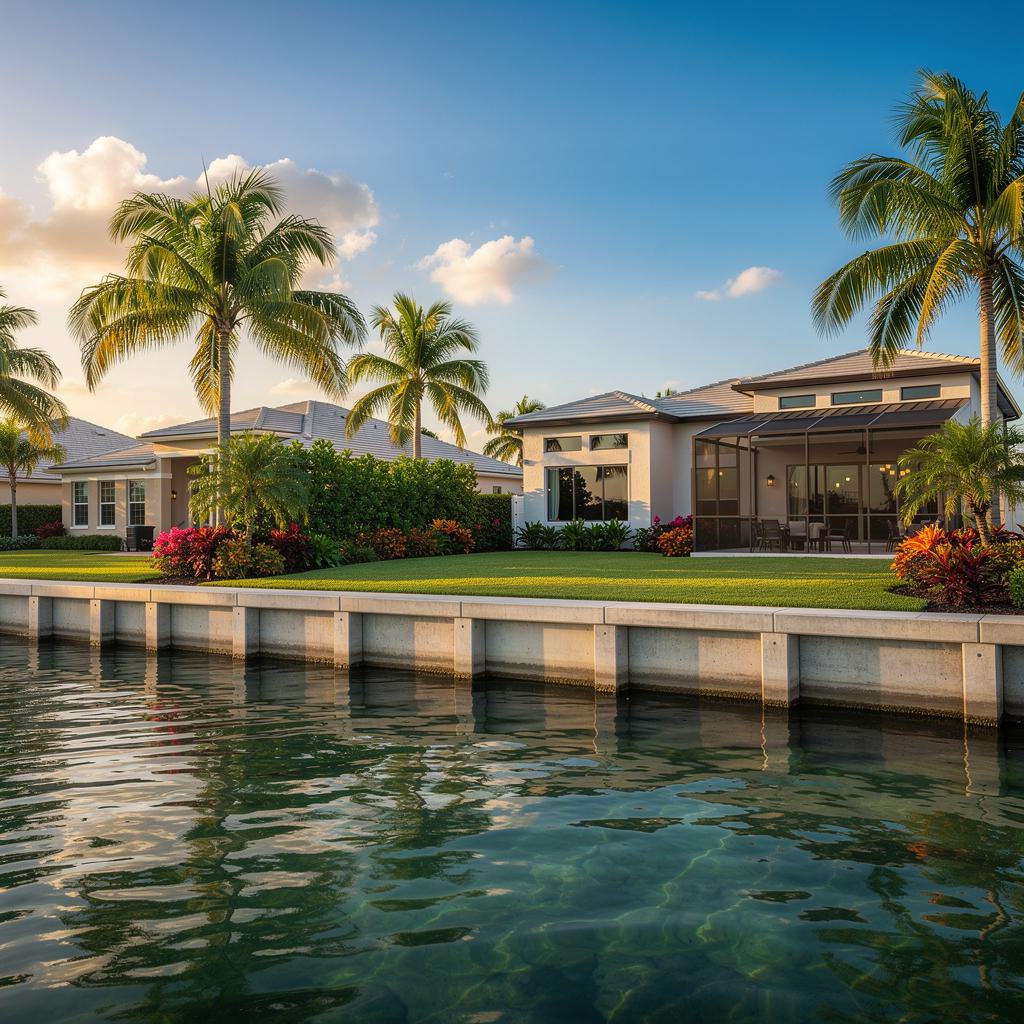
Concrete seawall panels are reinforced with steel rebar and fabricated to site-specific dimensions. We handle the full installation — driving panels to the correct depth, pouring the cap, installing tiebacks and deadman anchors, and setting up drainage through properly spaced weep holes. Every installation is permitted, inspected, and signed off before completion.
Cap Construction
The concrete cap runs along the top of the wall, binding panels together and anchoring the tieback system. It’s the most visible part of the wall and one of the most structurally critical. We pour caps with embedded rebar to marine-grade concrete specifications — finished to a clean, non-skid surface.
Concrete Seawall Repair in Cape Coral
Concrete seawalls are durable — but Cape Coral’s saltwater canal environment accelerates deterioration in ways that compound over time. Saltwater corrodes internal steel reinforcement from the inside out. Tidal pressure widens hairline cracks into structural breaches. Hydrostatic pressure from clogged weep holes pushes the wall outward. Our seawall repair specialists address every failure mode specific to concrete walls.
Common concrete seawall repairs we perform:
- Crack injection and surface sealing with marine-grade epoxy
- Cap removal and full replacement with reinforced concrete
- Seam repair at panel joints to stop soil loss and sinkhole formation
- Weep hole restoration and jet filter installation for drainage
- Helical tieback installation for leaning or rotating panels
- Polyurethane foam injection to fill voids behind the wall
- Rebar corrosion treatment and concrete patch repairs
How Long Does a Concrete Seawall Last in Cape Coral?
A well-built concrete seawall in Cape Coral lasts 30–50 years. Lifespan depends on original construction quality, reinforcement integrity, drainage performance, and maintenance history. The biggest accelerators of premature failure are clogged weep holes creating hydrostatic pressure, corroded tiebacks losing their hold, and unaddressed seam failures allowing soil to wash out behind the wall.
Cape Coral has thousands of concrete seawalls built in the 1970s, 80s, and 90s that are now approaching or exceeding their design lifespan. Many can be extended significantly through targeted repairs — without full replacement. We assess each wall honestly and recommend repair when it’s viable and replacement only when it’s genuinely necessary.
If your concrete wall is cracking, leaning, or showing rust stains, a professional seawall inspection determines exactly what’s failing and what repair method is warranted — before the damage reaches replacement territory.
Concrete Seawall vs Vinyl — Which is Right for Your Property?
Both materials work in Cape Coral’s canal system. The right choice depends on your site conditions, exposure level, and budget.
Concrete is the stronger choice for high-exposure shorelines, properties on the Caloosahatchee River or wider canals, and sites where maximum structural mass is required. It handles heavy wave action and storm surge better than any other material and is the only option for some commercial marine construction applications.
Vinyl is increasingly practical for residential canal properties under Cape Coral’s 2022 updated standards — it resists corrosion, installs with less disruption, and carries longer warranty coverage. For calm canal lots with moderate tidal exposure, vinyl is a cost-effective alternative.
We work with both materials and give you an honest assessment of which suits your specific waterfront — not the one that’s easiest for us to install.
FAQ — Concrete Seawalls in Cape Coral
Does Cape Coral require permits for concrete seawall installation?
Yes. All new seawall construction and structural repairs require permits through Lee County and the City of Cape Coral. We manage the full permitting process — from engineering drawings to final inspection sign-off.
How much does a concrete seawall cost in Cape Coral?
Concrete seawall installation costs depend on linear footage, site conditions, canal exposure, and engineering requirements. New construction is a significant investment — but it protects your property value, prevents land loss, and eliminates the far higher cost of emergency repairs or shoreline restoration. We provide a written estimate after a free site assessment.
What causes concrete seawalls to fail in Cape Coral?
The most common causes are corroded internal rebar expanding and fracturing the concrete, clogged weep holes building hydrostatic pressure behind the wall, panel seam failure allowing soil to wash out, and tieback corrosion causing panels to lean or rotate. Cape Coral’s saltwater canals and tidal cycles accelerate all four failure modes faster than freshwater environments.
What causes concrete seawalls to fail in Cape Coral?
The most common causes are corroded internal rebar expanding and fracturing the concrete, clogged weep holes building hydrostatic pressure behind the wall, panel seam failure allowing soil to wash out, and tieback corrosion causing panels to lean or rotate. Cape Coral’s saltwater canals and tidal cycles accelerate all four failure modes faster than freshwater environments.
How do I know if my concrete seawall needs repair or replacement?
Signs that warrant immediate inspection include horizontal cracking, visible rust staining, leaning panels, sinkholes or soil depressions behind the wall, and cap separation. A concrete seawall inspection gives you a written condition assessment and clear repair vs replacement recommendation.
Concrete Seawall Contractor Serving Cape Coral & Southwest Florida
Cape Coral Seawall has built and repaired concrete seawalls across Cape Coral, Fort Myers, and Port Charlotte for over 25 years. We know Lee County’s codes, Cape Coral’s canal conditions, and what concrete seawalls in this environment demand to last. Every project is permitted, engineered, and backed by experienced marine construction specialists.
Don’t leave a concrete seawall project — new installation or repair — to a general contractor without marine construction experience. The permitting process, tidal engineering requirements, and material specifications for Southwest Florida’s saltwater canals require specialists. Call us for a free consultation and site assessment.